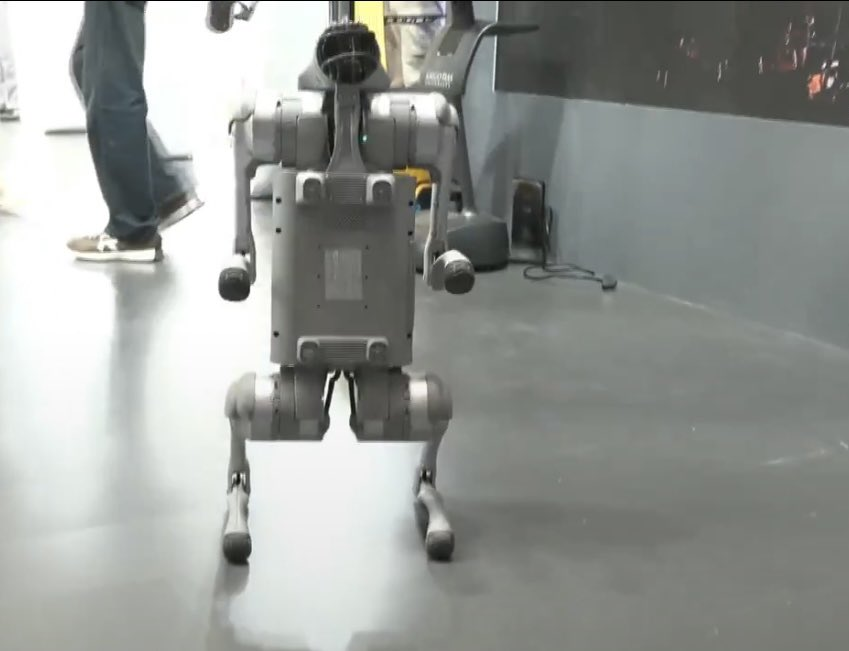
Recently, a robotic dog showcased by Galgotias University during the India AI Impact Summit held in New Delhi became the subject of widespread discussion on social media. The demonstration, which was part of an artificial intelligence and technology showcase, attracted attention after claims surfaced online that the robotic dog presented at the event was manufactured by a Chinese robotics company rather than developed by the university itself.
The robotic dog, commonly known as a "robodog," is a quadruped robot designed for advanced mobility, surveillance, research, and AI experimentation. Such platforms are widely used in global AI programs, research labs, and educational institutions where developers and students build AI models, automation workflows, and computer vision applications on top of existing robotic hardware.
The controversy began when videos from the India AI Impact Summit went viral, leading to allegations that the robotic dog was being presented as an indigenous innovation. This triggered criticism and online debate regarding originality and attribution in technology demonstrations. Following the backlash, Galgotias University issued a clarification stating that the robotic dog was not developed by them. According to the university, the robot was used purely for educational and demonstration purposes as part of the AI program to showcase practical applications of artificial intelligence and robotics learning.
The incident highlights an important reality of modern technological development. Innovation today often happens in multiple layers: hardware may be produced by one organization, while software development, AI experimentation, and application-level innovation are carried out by another. Without clear communication, such demonstrations can easily be misunderstood, especially when short video clips circulate online without full context.
The discussion also reflects the growing public interest in AI and robotics in India. As AI-focused events and summits become more common, expectations around transparency and technical clarity are increasing. Educational institutions and technology organizations are now expected to clearly specify whether they are showcasing original inventions, research implementations, or commercially available platforms used for academic purposes.
In conclusion, the Galgotias robotic dog controversy serves as a reminder of how quickly technology narratives can change in the age of social media. While the demonstration was part of an AI-focused program, the situation underlines the importance of accurate representation and clear communication when presenting emerging technologies to the public. Such discussions, however, also indicate a positive shift: growing awareness and scrutiny around innovation as India continues to strengthen its position in the global AI ecosystem.